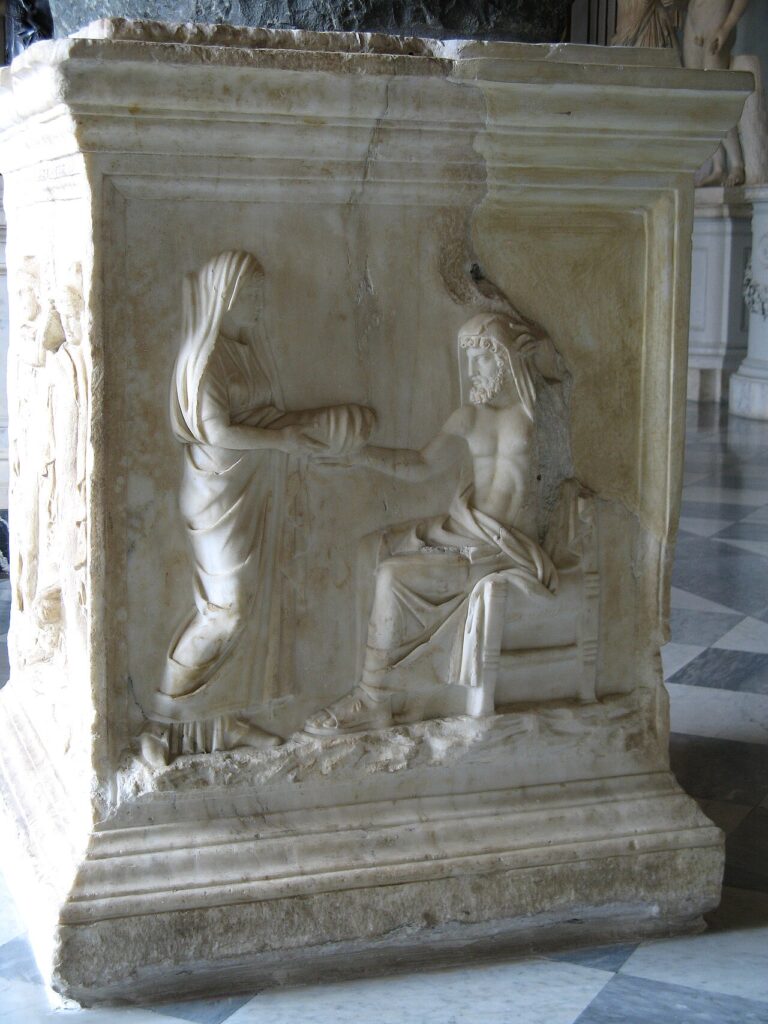
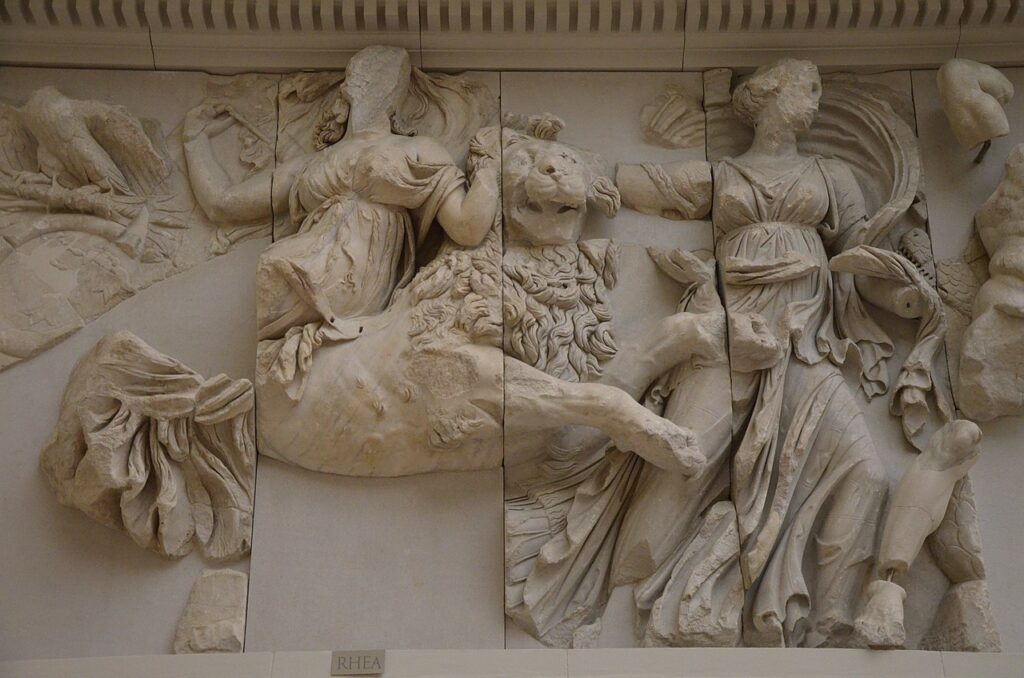
Rhea : the daughter of Gaia and Uranus, was a Greek Titan and the mother of the Olympians. Along with the other Titans, Rhea was imprisoned in Tartarus by her tyrannical father; she was eventually liberated by her brother Cronus, whom she married. Rhea gave birth to the Olympian deities and, through her cunning, helped them overthrow Cronus and establish a new cosmic order.
Hailed as “Mother of the Gods,” Rhea was revered across the Hellenic world. She was especially popular on the island of Crete, where the infant Zeus was said to have come of age. Rhea was also held in high regard by the Orphics, who believed that she had conceived the goddess Persephone with her son Zeus. In art and literature, she was often conflated with Cybele, an Anatolian mother goddess whose cult was imported to the Greek world in the fourth century BCE.
19 THE THIEVES : In Crete there is said to be a sacred cave full of bees. In it, as storytellers say, Rhea gave birth to Zeus; it is a sacred place and no one is to go near it, whether god or mortal. At the appointed time each year a great blaze is seen to come out of the cave
§ 36 PANDAREUS : When Rhea, fearing Cronus, hid Zeus in the Cretan cavern, a goat offered her udder and gave him nourishment. By the will of Rhea a golden dog guarded the goat. After Zeus drove out the Titans and deprived Cronus of power, he changed the goat into an immortal. There is a representation of her among the stars to this day. He ordered the golden dog to guard this sacred spot in Crete. Pandareus son of Merops stole the dog and carried it off to Mount Sipylus. He gave it to Tantalus, son of Zeus and Pluto, to guard. After a time Pandareus went to Mount Sipylus and asked for the dog. Tantalus swore he had never received it. To punish him for the theft Zeus turned Pandareus into a rock where he stood. Tantalus, for going back on his oath, he struck down with a thunderbolt and set Mount Sipylus on top of his head.
Antoninus Liberalis, Metamorphoses
The Metamorphoses of Antoninus Liberalis, translated by Francis Celoria (Routledge 1992), still in copyright, permission requested from the publishers. This text has 163 tagged references to 104 ancient places.